Posts

Showing posts with the label #Gush Katif

BETWEEN A ROCK AND A HARD PLACE - I

At the height of the election campaign in 1977, the Labour Prime Minister, Yitzhak Rabin, visited the first moshav (Netzer Hazani) to be set up in Gush Katif.  In a symbolic gesture, Rabin affixed a mezuzah at the entrance to the home of the Yefet family and declared: “This is a big day for the State and the settlement movement, a day which symbolizes the foundation of our attachment to the region which, since the Six-day War, has become an inseparable part of the State and its security.” Nine years later, when Rabin was Minister of Defense in the National United Government Peres-Shamir, he made a return visit to Netzer Hazani and declared, almost word-for-word, the same speech he had made in 1977. When the Herut party won the 1977 elections for the first time, Prime Minister Menachem Begin, had to uproot close to twenty young settlements in the framework of the Camp David Accords. However he strongly opposed the proposal to return Gaza to Egypt. He promised that the preceden...

REVISITING GAZA - II

Image
From the burning of the fields in 2018 in kibbutz Be’eri,  to burning families in kibbutz Be’eri on October 7 th , 2023 .                                                                                                   In 1978, when Simcha my oldest daughter got married, she and her husband went to live in the second moshav (agricultural settlement), Gannai Tal, to be established   in Gush Katif in the Gaza Strip . Since the houses had not yet been built, the other married members lived together as bachelors in one building, in order to work on their farms. On weekends they went to their respective homes. Simcha and her husband, Gideon, were newly-weds so they started their married ...

REVISITING GAZA

Image
Jews and their Israelite ancestors had lived in Gaza since Biblical times. An historic Jewish community existed in Gaza City prior to its expulsion by the British, for safety reasons (after many had been massacred), during the infamous 1929 riots by the city’s Arabs.   Land for the village of Kfar Darom (in the Gaza Strip) was purchased in the 1930’s and settled in 1946. It was evacuated following an Egyptian siege in the 1948 Arab-Israeli War. In1968, Yigal Allon presented an initiative for the founding of two paramilitary  settlements in the centre of the Gaza Strip. He viewed the breaking of the continuity between the northern and southern Arab settlements as vital to Israel's security in the area - which had been captured the previous year in the 1967 Six-Day War. In 1970, Kfar Darom was re-established as the first of many Israeli villages in the area. Allon's idea was ultimately designed with five key areas slated for Israeli presence along the length of the ...

A DIFFERENT KIND OF ARMY - II

Image
Every year, the residents in the   senior residence complex where I live, donate money for a different grassroots non-profit organization. This year, the iniators of this yearly project have decided to support an organization called OneFamily.   The list of deaths from Arab terrorist attacks in Israel is never ending. Since 1920 (many years before the “occupation”) up to the year 2018, 3,831 fatalities have been recorded in Israel! The list does not include the thousands who were injured, many very severely.    Numbers cannot do justice to each individual family of victims of terrorism – all of whom have to cope with their unbearable loss, pain and helplessness. My daughter, Simcha Rivlin, wrote: “Exactly 15 years ago, 12/1/05, my husband Gideon Rivlin was killed from a   roadside bomb which was planted there by terrorists in Gush Katif. I  was left with five children: Nir, Yaara, Omer, Assaf and Gilead in Ganei Tal , one of the small ag...

DYNAMICS OF GRANDCHILDREN IN THE IDF

Apart from Nir (see blog 34), two of his three brothers are also in the Reserves ( miluim). Omer served as a squad commander of recruits   in the Givati regiment during his army service, and was later assigned as commander of a   squad dealing with anti-tank missiles. He was in the middle of his service when his father was murdered. Six months later they lost their home in Gush Katif when the whole of the Gush was evicted. Unfortunately, it was the army which had to carry out the eviction. Omer refuses to speak about it. He was certainly not the only soldier whose home was in Gush Katif at the time and faced with such a terrible dilemma. When Omer is called up for miluim, he is responsible for a specific sector on the Gaza Strip border (an area where he once lived). Apart from his regular miluim   - whenever there is trouble in the area an emergency call goes out to the Reserves, which has to be answered to immediately. Like his father and three brothers, Assaf ...

OUT OF THE ASHES

Encouraged by the government back in the late 60’s and early 70’s to settle and develop Gush Katif, the settlers’ ideology and faith gave them the momentum to make the region blossom. They were so connected to the land itself, that they simply couldn’t imagine living anywhere else. When their communities were destroyed, completely crushed and dismantled, they relied on that same ideology and strength of character to persevere, rebuild and still radiate a warmth that only those from such small towns and villages can radiate. Simcha’s youngest son, 23 year old Gilead,  has been serving in the IDF for three years and five months. Since his father had been murdered on army duty he was exempt from serving in a fighting unit and his mother had to sign a special document in order for him to do so. “From the time I was recruited, I was determined to join a “fighting”  unit but  wanted something different, something a little harder, more challenging. I was taught, from an ...

AFTERMATH - II

Image
Simcha was devastated as she had to both support her five children and to create a new home in a completely unfamiliar and unstable environment, facing an uncertain future. We were not aware of the great toll it took on her physical and mental health as she put on such a brave front. It was only when we discovered that she was suffering from malnutrition (she lost 11 kilo) that steps were taken to boost her both physically and psychologically. All the children suffered traumas which have repercussions - until today. The only bright spot was the warm and unstinting support she received from her community all of whom stayed together, the strong helping the weak. The members of the moshav who had been working outside in various jobs were able to continue to support their families. The majority, who were farmers had no land to work on, even if they would have had the necessary will, stamina and ability to start all over again. Also many of them had been employed in the Gush with no ...

AFTERMATH

In 199 5 , Israel disengaged from 85% of Gaza and 100% of its population living there. The disengagement created the largest terrorist base in the world, led/harboured by PLO graduates of terrorist camps in Yemen, Iraq, Sudan, Syria, Lebanon and Tunisia The disengagement was interpreted, by terrorists, as a retreat from the role-model of countering terrorism (Israel), and a reward to the role-model of terrorism (PLO/PA). It has inspired Islamic terrorism, which also threatens pro-US Arab regimes. The day immediately after the disengagement, the nine thousand Jews from Gush Katif and Northern Shomron, found themselves scattered at random in hotels and youth hostels, with no idea of what their next steps would be. No strategy was planned to re-settle or re-integrate them. The compensation packages significantly undervalued their assets, and hardly covered basic living expenses during the lengthy period of unemployment. Most had to use some of the compensation monies to pay off their m...

A SHATTERED DREAM

Image
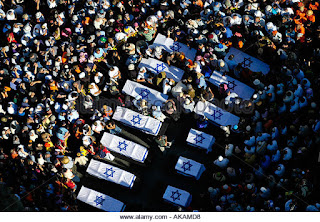
On January 12 th 2005 a terrible tragedy struck our family – our beloved son-in-law, Simcha’s husband Gideon, was murdered by terrorists. Since the Israeli Defense Forces were responsible for the defense of settlements in the Gaza strip, Gideon had been driving in an army jeep to determine where to build a security fence at one of the settlements - Morag. While they were traveling in the area of the greenhouses around which the fence was scheduled to be built, the jeep was suddenly blown up by a roadside bomb which was detonated by two terrorists. Gideon, who was driving, was killed outright and the vice battalion commander who was sitting next to him lost his leg. The two young 19 year-old soldiers sitting at the back were miraculously physically unharmed but severely traumatized. Gideon’s oldest son, Nir, who worked together with his father and was supposed to be with him at the time, was held up and didn’t accompany him to Morag. To compound the tragedy, in August of the ...

GUSH KATIF - II

Image
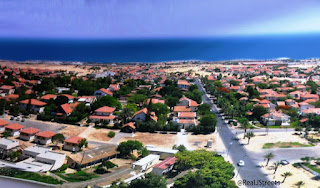
GUSH KATIF – II Gush Katif – 10 years old Since Gush Katif was planned as a strategic buffer between Israel and Egypt, people were given incentives to join and were offered a small house (not yet built) and a greenhouse. Ganei Tal , which Simcha (my first-born) and her husband, Gideon , decided to join, was the second moshav to be built there. Since the houses had not yet been built the other members, who were all married and lived elsewhere, had to leave their families in their homes at the beginning and lived together as bachelors in one building, in order to be able to start work in their greenhouses. Simcha and Gideon, who were newly-weds, started their married life living in an old caravan and turned it into a home - although Gideon was so tall that his feet stuck out of the “bedroom” window! Their next “home” was an old bus from the time of the British mandate which Gideon shlepped from the Tel-Aviv old ...

Remember GUSH KATIF?

Jews and their Israelite ancestors have lived in Gaza since Biblical times. A historic Jewish community existed in  Gaza City  prior to its expulsion by the British, for safety reasons, during the infamous 1929 riots by the city's Arabs. Land for the village of  Kfar Darom  was purchased in the 1930s and settled in 1946. It was evacuated following an Egyptian siege in the  1948 Arab-Israeli War . Gush Katif began in 1968, when  Yigal Allon  presented an initiative for the founding of two  paramilitary settlements in the center of the Gaza Strip. He viewed the breaking of the continuity between the northern and southern Arab settlements as vital to Israel's security in the area, which had been captured the previous year in the 1967  Six-Day War . In 1970, Kfar Darom was re-established as the first of many Israeli agricultural villages in the area. Allon's idea was ultimately designed with five key areas slated for Israeli presenc...